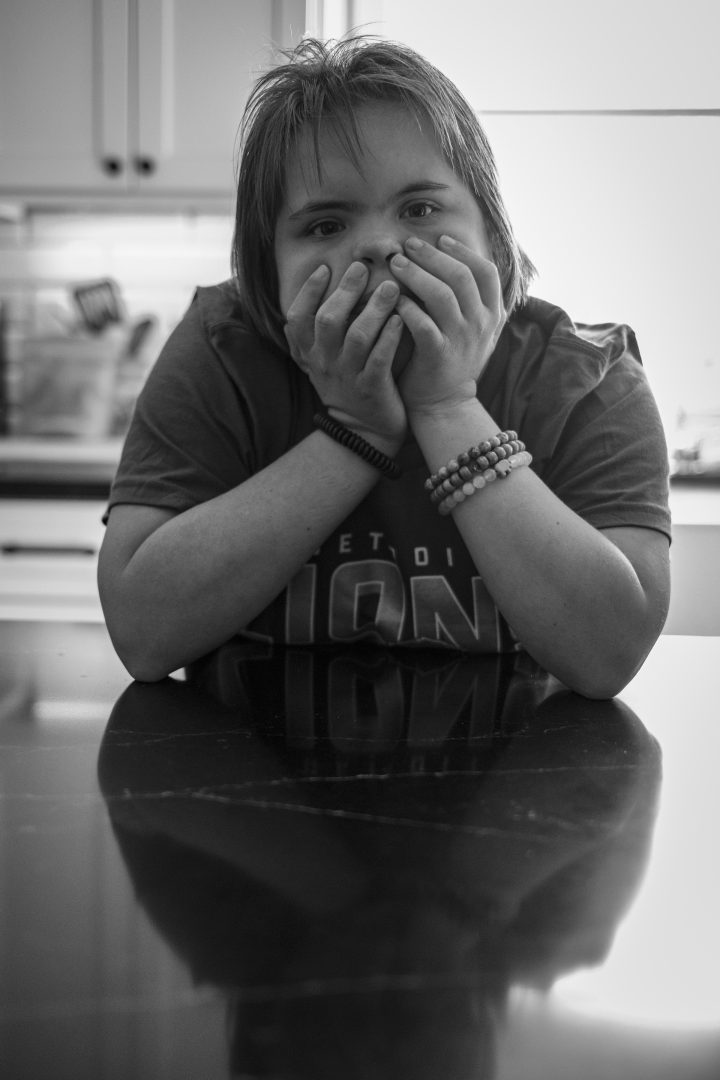
October is Down Syndrome Awareness Month; and as a dutiful dad and photographer, I hauled a reluctant teenage daughter in front of my camera for a quick photo session to commemorate the first day.
As a photographer’s kid, Julia is accustomed to this. I can’t tell you how many times I’ve made impolite noises to get her to smile. She resisted at first, but she finally loosened up and got into it. It’s always a give-and-take between us – she poses, I direct, she adjusts, and we typically walk away with something worthwhile.

We were over 40 frames in when that familiar and satisfying moment of “getting the shot” finally happened. One of my favorite photographers of history calls it the Decisive Moment, describing the “exact instant when a photographer captures an event, freezing it in a frame where form, content, and emotion are perfectly balanced.”

I was thunderstruck. Looking at that image – the hands and eyes especially – still takes me down a “rabbit hole” of emotion, wanting to know our daughter’s mindset in a new season of her life.
She just turned 15. She has successfully entered high school. She has a good team of teachers and staff supporting her there.
When she’s in public (especially Friday night football games), she doesn’t want us within 30 feet of her most of the time. As her parents, we are a settled and safe reality. Julia also has rich friendships with other kids with Down syndrome. But like her friends – both typical and neurodivergent – Julia is scanning the horizon looking for her “other people”.
As I looked into the soulful eyes of the girl in that photo, considered the life she’s living with all the attendant joys and frustrations, I became a little less of a fan of Down Syndrome Awareness Month.
Awareness…
It’s not a particularly satisfying challenge in this season of Julia’s life. “Awareness” is a flimsy term that doesn’t ask a lot of us. Anyone who follows me on social media is aware of her and some of the life she lives. In the end, Julia needs far more than awareness as she makes her way through the minefield of high school socialization.
Consider a photo I took a few weeks ago of the goings on in the bleachers at a recent football game, and ask yourself a question:
Who in this picture is aware of Julia and who is engaging with her?

Pretty obvious, right? Pretty low cost for that student as well. After chatting with Julia for a few minutes, he moved on and was eventually replaced by someone else who sauntered by and sat down with her. But the bonus was that he was modeling how it was done for everyone around them.
A simple act of turning aside – an easy deposit of kindness.
But for the parent of a kid with special needs who is trying to find friends, despite their increasingly divergent developmental journeys, it’s 24-karat gold.
Our hearts were refreshed as we witnessed the simple interaction between Julia and that student. We don’t know his name – but she does. And he knows hers.
And it gives us hope that maybe there are other kind souls willing to slow down, come alongside and walk with her for a season.
Julia longs for a community committed to taking a scary but soul-filling step through awareness and into engagement. Why? Because it is the beginning of a journey that is life-giving for everyone.
Engagement sets aside our personal agendas and dares to enter the world of another. That in itself is an utterly counterintuitive move in a culture that demands personal achievement and continuous improvement.
Engagement pro tip? It’s even better when that person has nothing of immediate value to offer back.
I’ve often asserted that it’s not innovation or accumulation that moves a community or even a nation forward. It’s kindness. And in a world that puts its thumb on the value scale, biasing toward achievement, accumulation and consumption, kindness is often given short shrift.
Engagement gives us the chance to recognize the legitimacy of that person’s world and the intrinsic value of their perspective – even if we don’t totally understand it. It sweeps aside worldly pecking order of strength and achievement for something closer to God’s intention for humanity. And it’s just the beginning.
Committing to a rhythm of engagement leads to Inclusion, where an invitation is extended to that person to enter our world. It takes a little more commitment. Inclusion involves slowing down and making space and maybe even re-working the “rules of the game” so that others can “get in the game” and taste the exhilaration of the shared experiences we take for granted.
Julia got a sample of inclusion over homecoming week where the football team let her and some of her pals with various disabilities run a play during the halftime of an exhibition game.

Any progress along the continuum from awareness to inclusion makes the whole world better. But the peril remains to slip back into comfortable rhythms of self-promotion (and self-congratulatory pride) once the conversation on the bleachers or the exhibition football game is over.
The true adventure happens when we decide that others are more important than us and we choose Belonging, seeing even personal inconveniences and disruptions as part of the adventure that a loving God has for us to grow further into our better selves.
In belonging, our worlds are intentionally and collaboratively merged in the real give-and-take of life together as co-equal stakeholders. This is where life flourishes not merely for the privileged – but for all. Belonging lets a person bring their full self, knowing that they are valued and wanted and will join everyone in the journey toward growth.
Much of God’s redemptive work in this broken, divided world is to peel back our carefully constructed layers of self-protection and comfort, opening us up to more of the richness of life He has always intended for us.
The reality is that we – regardless of upbringing, skin color, or myriad other genetic or social markers – belong to each other.
It was described in detail by the 1st Century church planter Paul in his letter to a community that had become riven with division, exclusion and one-upmanship. Relating life together to a human body, he offered a weighty challenge:
The eye cannot say to the hand, “I don’t need you!” And the head cannot say to the feet, “I don’t need you!” On the contrary, those parts of the body that seem to be weaker are indispensable < emphasis mine >, and the parts that we think are less honorable we treat with special honor… – 1 Corinthians 12:21-23a
In God’s marvelous economy, the people least expected to “move the species forward” are the ones, in the end, most vital to the survival of the species.
These words have survived two millennia, but the truth behind it is far more ancient.
Creation itself has seemingly lowly but necessary organisms hardwired into every biome and ecosystem on earth. If they disappear, it goes unnoticed at first. But over time, their vacated roles of pollination, decomposition, food source, pest control, soil aeration, and a host of other functions leads to the decay and eventual demise of the ecosystem.
Let me be clear: I am not comparing Julia or anyone else’s child to mere plankton. My point is that everyone in a community can contribute to the common good; and it’s often in ways that the “top of the food chain” fails to understand.
How are Julia and folks like her indispensable to us? How are they vital to our humanity?
If we take that brave journey from awareness to engagement to inclusion, and finally to belonging, a profound reward awaits us along the way. By setting aside personal agendas – by hitting “pause” on our ultimately useless striving, we will occasionally touch the wide, open pasture of self-forgetfulness.
But perhaps more importantly, it strikes a blow against the worldly lie that we are only as valuable as what we produce.
It’s an admittedly strange space to live in on this side of heaven, but Jesus himself said that by holding our own dreams more and more loosely and giving more of ourselves away, we gain a taste of the real and rich “good life” that God originally designed for everyone.
You, and I, and everyone else are works in progress on this adventure.
Julia is still hard at it, scanning the horizon for her “other people.” Pondering in her own way where else she belongs outside of the rich relationships she already has. My prayer is that there are good souls out there who will make space for her and experience something wonderful when they do.
2 Responses
Thank you for sharing this. Encouraging and challenging. Is there a way I can share your article with a couple of my friends who have children with special needs?
Of course! Just share this link…
https://jchriscook.com/2025/10/15/beyond-awareness/